John Clare’s stay in his Northborough home after walking back from High Beach in July 1841 was short lived. His wife Patty already had their family and her father-in-law, Parker Clare (who died aged 81 in 1846), to care for. Despite her best efforts she was unable to cope with her husband’s mood swings and erratic behaviour.
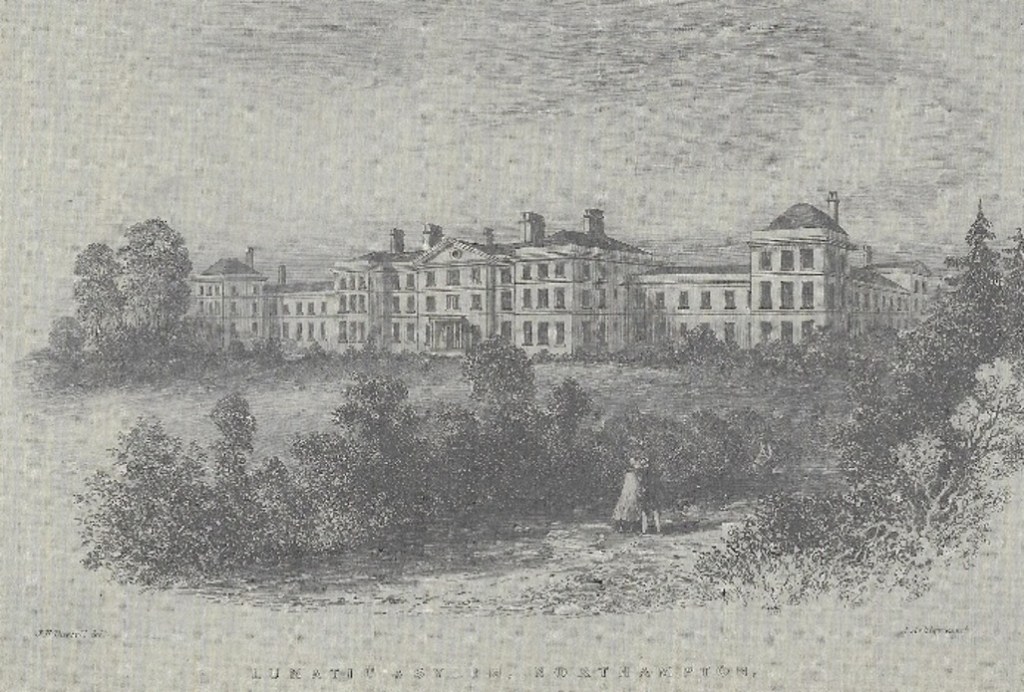
It all came to a head in December 1841. Clare’s friend Revd. Charles Mossop, vicar of Helpston (1793-1883) [1], who continued to visit him in Northborough and invite him to Helpston, saw a decline that had ‘generated conduct which became so alarming that to his wife and family as to induce them to ask for aid’ [2]. With the help of his patron Earl Fitzwillilam, Clare was found a place at the newly owned public asylum in Northampton. On 28 December 1841 Fenwick Skrimshire (a Peterborough doctor who was first called in when Clare became ill in 1820) along with Market Deeping surgeon William Page, certified Clare ‘insane’ and the following day he was admitted to the Northampton General Lunatic Asylum. On admission one of the ‘triggers’ identified for his purported ‘hereditary’ insanity, was from ‘years addicted to poetical prosing.’ Whatever the cause, John Clare was to remain there for the last twenty-three years of his life.
The asylum was built around 1837-1839, functioning as a charitable, non-profit institution. It was extended between 1840 and 1897 to accommodate growing patient numbers. It stood in an elevated position about a mile to the east of the town, looking over the park and woodland of Delapre Abbey, the vale of the River Nene, and Hunsbury Hill beyond. Originally built as a quadrangle in fine white stone, it was much the grandest building that Clare had ever lived in.
There were galleries for promenading in wet weather and day rooms furnished to look as ordinary as possible. Hot water was accessible in all parts of the building, a luxury previously unknown to Clare. Baths and showers were provided and there was a state-of-the-art laundry. Paupers were admitted but Clare was among the paying patients [3].
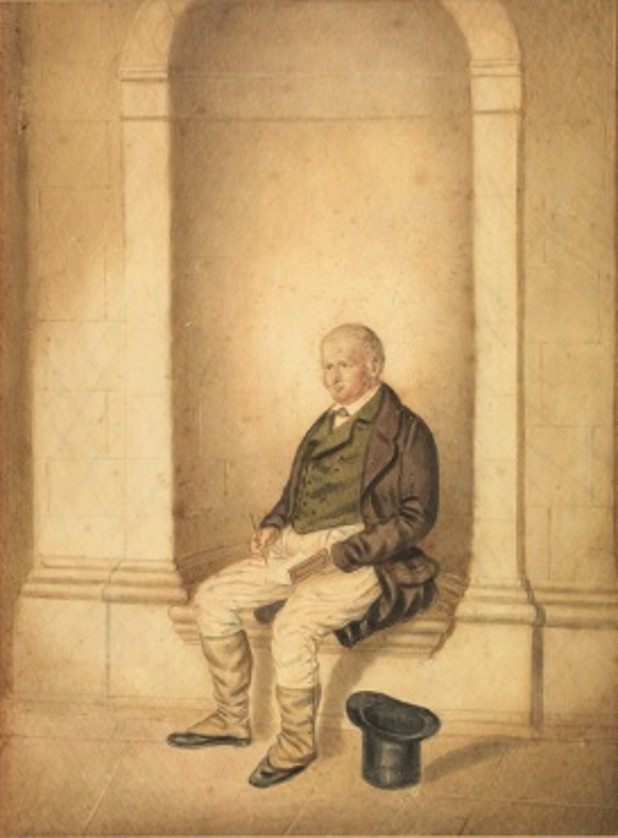
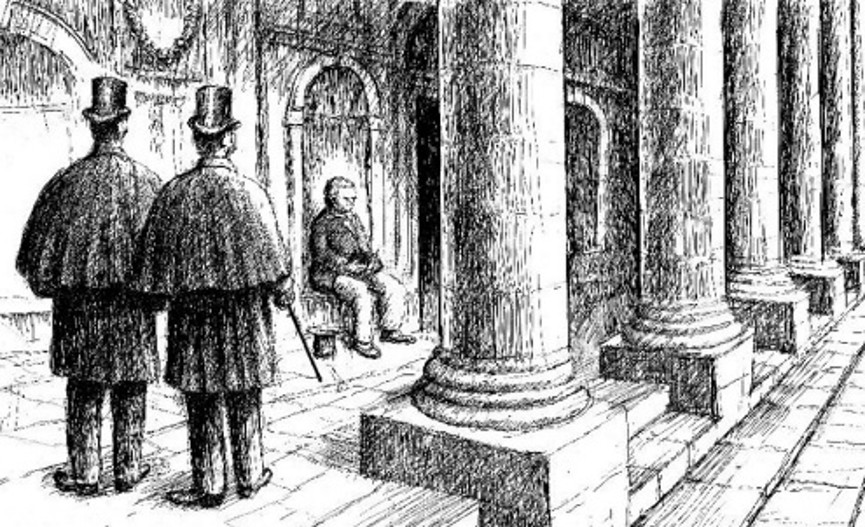
The asylum superintendent was Dr Thomas Prichard who was strongly sympathetic to the new ‘moral management’ approach. He banished all mechanical means of restraints from his regime. His successor in 1845 was Dr Nisbett who continued his liberal regime. The ‘fifth class’ or harmless patients were given considerable freedom, and Clare was allowed to walk into Northampton alone, where he became a well-known figure, sitting for hours in the portico of All Saints Church, always with his tobacco and sometimes with his notebook. In a number of sketches and paintings by local artist George Maine he is shown in this favourite spot. He also received visitors at the asylum, including his son Charles [4].
Nisbett was later succeeded as Superintendent by Dr Edwin Wing, who remained there until shortly after Clare’s death. The building is still a mental health facility today, now called St. Andrew’s Hospital.
Despite his confinement, with the degree of freedom, John Clare continued to write, producing an immense amount of poetry in the asylum, including some of his best known and loved, including ‘I Am’, ‘Little Trotty Wagtail’ and the moving ‘To Mary’, which begins with the lines ‘I sleep with thee, and wake with thee/And yet though art not there’. In the Robinson et al manuscripts they comprise of some 500 items running across more than 1,700 pages [5]. That we have them is primarily due to William Knight, a staff member at the Asylum whom Clare had grown close to and who became a friend and supporter.
In 1845, Knight was promoted to the post of house steward in the asylum. The previous year, he had begun compiling a notebook, which was to run into two volumes, which he entitled Poetry by John Clare written by him while an Inmate of the Northampton General Lunatic Asylum. They comprised transcripts of manuscript poems given to Knight by Clare. Some had been left unfinished after Clare had been interrupted. Knight records that Clare would then completely stop and would not be interested in any future revision. Knight admired Clare and was proud of the work he had done in preserving his work. Bate notes that the two volumes compiled by Knight ‘are our principal record of Clare’s output in the Northampton years’ [6]. He goes on: ‘Clare’s identity depended on his poetry: to stop writing was to cease to be himself. Knight saw it as his job to help keep the poems coming’.
Just before Christmas 1846, Knight wrote to Thomas Inskip (see profile below) enclosing examples of some 150 poems, including ‘I Am’ which Inskip described as ‘exquisitely beautiful’. In 1848, when Clare’s son Charles visited the asylum, Clare gave his consent for the poems written and still in the Northborough cottage to be handed over to Knight who was eager to arrange publication. Though nothing was heard further of the project, Bate is of the opinion that, ‘A gathering of the fugitive poems in magazines and newspapers in the 1830s and 1840s, the High Beech material, and a substantial selection from the Knight transcripts would have profoundly enhanced Clare’s reputation’ [7].
One of the last poems Knight transcribed was a sonnet of farewell that ends with the words ‘How can I forget?’, the same words that Clare used at the end of his Journey Out of Essex when he arrived home from High Beach and found no Mary Joyce (she had in fact died in a house fire tragedy in 1838 and was buried in Glinton churchyard).

In 1850, Knight moved to another post in Birmingham and took with him two stout volumes of Clare’s transcribed poems and lyrics. At the beginning Clare and Knight kept in touch by letter. One letter from July 1850, is particularly moving [8]. Knight continued to work in Birmingham at the Borough Asylum (now called Winson Green) until 1892.
Thomas Inskip (died 1849) was an elderly watch- and clockmaker from Shefford, Beds, who became an outside advisor and sometime drinking partner of Clare. They had met in the 1820s and Clare was still a correspondent while in Northampton asylum. He was good at defusing Clare’s delusions. He was also an acute critic singling out ‘An Invite to Eternity’ as ‘bordering on sublime’. It was Inskip who helped arrange publication of some of Clare’s poems in the Bedford Times between 1847 and 1849, including ‘I Am’ [9].
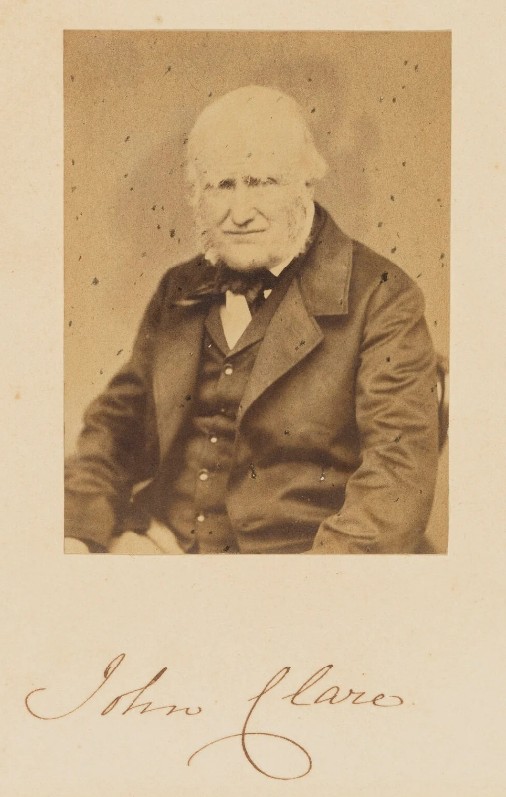
© National Portrait Gallery. Click for larger image.
Revd. Charles Mossop (1793-1883) was vicar of Helpston; his vicarage was just across the road from Clare’s cottage. At the end of 1818, when Clare first showed him some of his poems, Mossop was twenty-five, an orthodox Anglican and had only recently been installed as vicar. He encouraged Clare in his poetical aspirations. He also had a hand in Clare’s move from Helpston to the cottage in Northborough and Clare expressed thanks, in a farewell note of 28 April 1832, for all the support Mossop and his sister Jane had given over the years [10]. Mossop remained a contact for Clare and was always inviting the poet back to Helpston to stay with him [11]. During Clare’s remaining five months at home between High Beach and Northampton asylums, Mossop visited Clare’s cottage in Northborough on several occasions and described the poet as ‘a stranger to his own family’ [12]. Mossop, who had moved from Helpston to Etton, attended with his sister Jane, Clare’s funeral in Helpston in 1864.
Notes
Much of this text is drawn from Jonathan Bate’s biography and I am grateful to him for permission to reproduce it.
1 See Gary Alderson’s lecture from the 2024 John Clare Festival, ‘Charles Mossop – the Good Vicar?’ in the John Clare Society Newsletter, No.153 (October 2024) and No.154 (February 2025).
2 Jonathan Bate , John Clare: A Biography (London: Picador 2003), page 465.
3 Bate, pages 468-469.
4 See Bob Heyes, ‘A Neglected Account of Clare in the Asylum’ in JCSJ, No.13, July 1994, pages 59-60. The article reproduces an account by George Kearley of a visit between 1857 and 1862.
5 Eric Robinson and David Powell (eds), The Later Poems of John Clare 1837-1864, Volumes I and II (Oxford: Clarendon Press 1984).
6 Bate, page 487.
7 Bate, page 493.
8 Mark Storey (ed.), The Letters of John Clare Clarendon Press, Oxford, 1985), page 678. The John Clare Society is a partner in the ‘John Clare Then and Now’ project which is producing a new edition of Clare’s letters, edited by Tim Fulford, John Goodridge and Bob Heyes, supported by Dr Erin Lafford and Dr Adam Bridgen. It will be published by Liverpool University Press.
9 Bate, pages 487-490.
10 Bate, page 363.
11 Bate, pages 392-393.
12 Bate, page 465.


You must be logged in to post a comment.