Following their marriage in 1820, John and Patty Clare lived with their newborn child, Anna Maria, in one of the small ‘one-up one-down’ tenement cottages in Woodgate, Helpston, next door to his parents. By 1832, and with a growing family of six young children from one to eleven years, it was becoming increasingly intolerable for Patty in particular, who was anxious to move. John’s farming had also become unprofitable, income from poetry had reduced to a trickle, his relationship with his publisher John Taylor more distanced and he was in debt to his landlord.
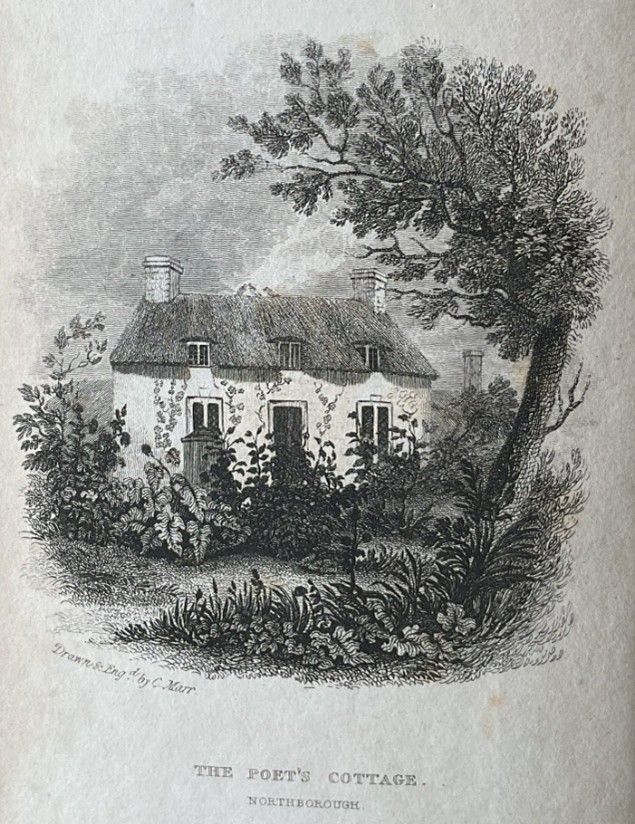
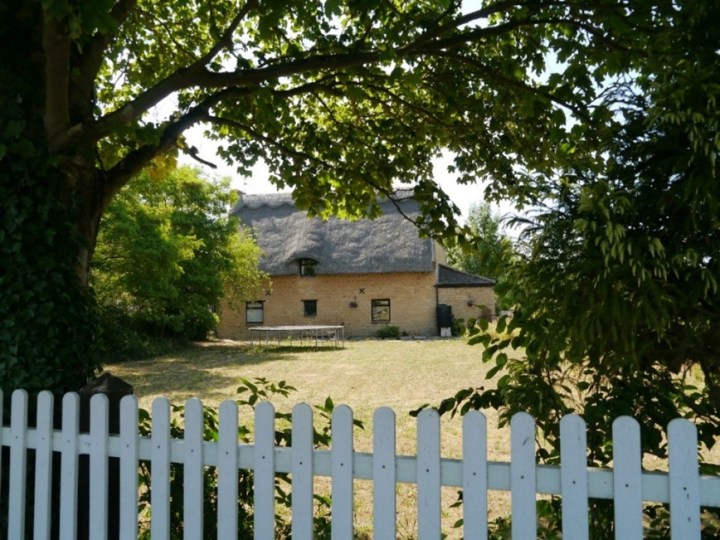
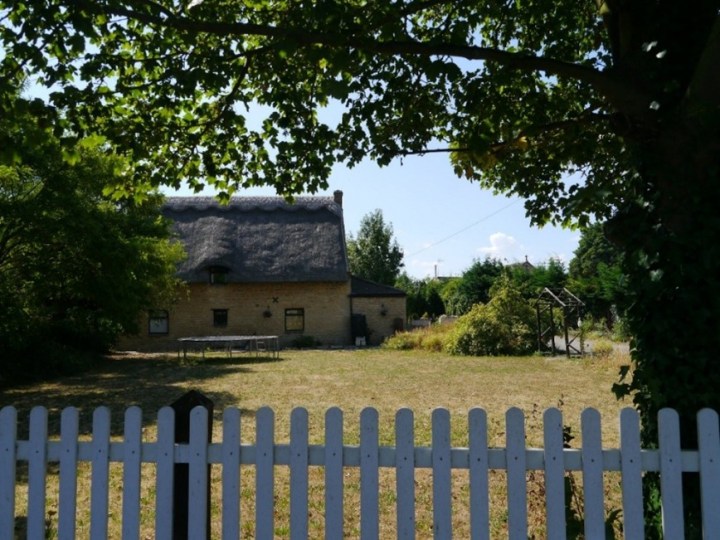
Then an opportunity arose through one of his supporters, Lord Milton. He had built a new cottage three miles away in the village of Northborough and agreed that the Clares should be the first tenants. Much more spacious than the Helpston cottage, it was detached and thatched, had a sitting room, which Clare used as a study, a kitchen and back kitchen. Upstairs were three bedrooms, one of them tiny. It also included two acres of land, room to have two cows, an orchard and garden. At a rent of around £15 per year, it was a lot more expensive than the Helpston tenement and Clare also had to pay 6s 8d half yearly to the Northborough Poor Rates. A recently discovered Northborough Overseers of the Poor Book has an entry for John Clare. Fortunately, another of his long-time supporters and admirers, Eliza Emmerson, helped raise funds for the move and livestock.
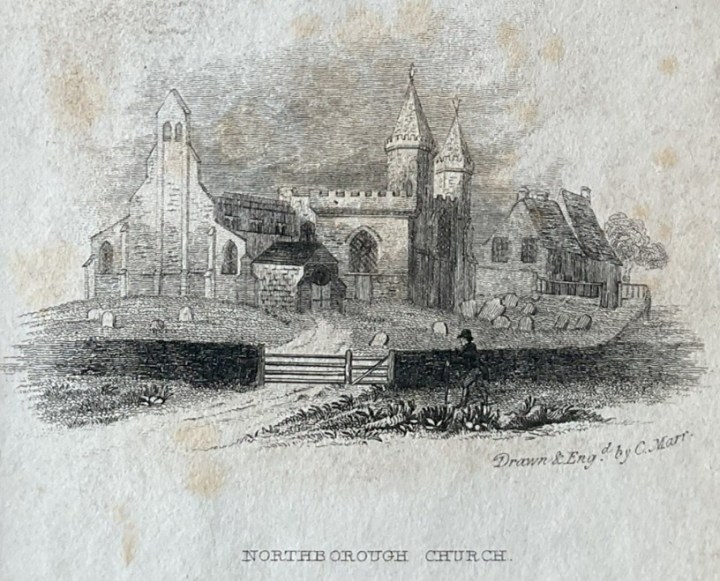
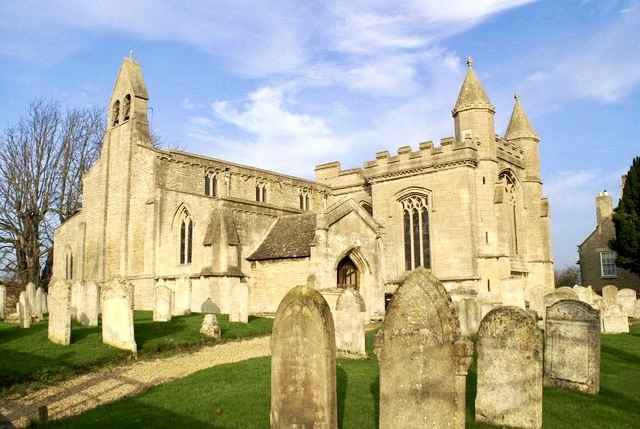
At the centre of the village was the ancient church of St Andrews, and a manor house that had once been the home of Oliver Cromwell’s favourite daughter Elizabeth, who had married Sir John Claypole. Bate (JB 388-389) describes the location as follows: ‘Most of the cottages had sizeable gardens and often an orchard or paddock. The width of the road and the wealth of trees and flowers make it look a more picturesque and prosperous place than Helpston.’ The village had a population of 221 in 1831. It has been described as an isolated, inward-looking community with gossips complaining about John Clare’s preferential treatment due to his special relationship with Lord Milton. Would the village ever feel like home to John Clare?
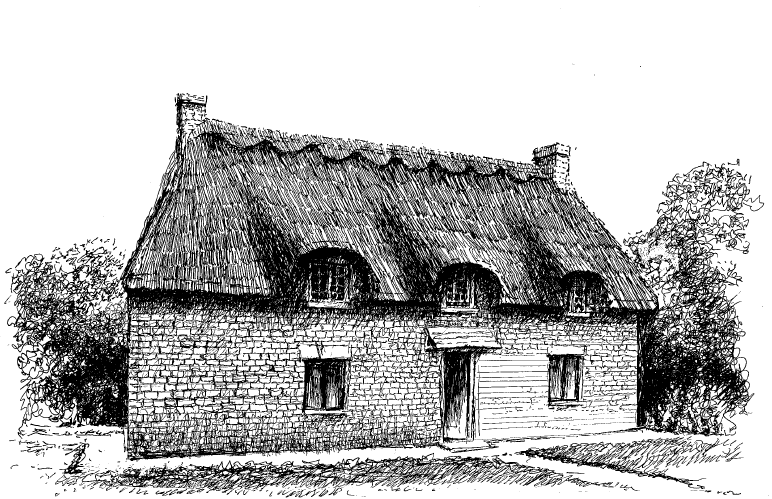
The move took place on Monday 30 April 1832 (JB 363). The Clare family had to walk the three miles, which was a considerable undertaking with six children, at least one cat, a large oak bookcase, some three hundred books and Clare’s manuscripts (JB 363). It was described by a Northampton newspaperman and Clare enthusiast in 1872: ‘a pleasant three miles; along a road level far-stretching; with the tall slender spire of Glinton in the distance; through the pretty village of Etton; and along “the bank”, one of those works peculiar to the country, constructed for the purpose of directing and governing the flood waters’ [JB 387]. But how did John Clare really feel about the move? Perhaps with mixed emotions: ‘He was going out of his knowledge, away from the parish of Helpston that had mapped the contours of his very being’ (JB 387-388)
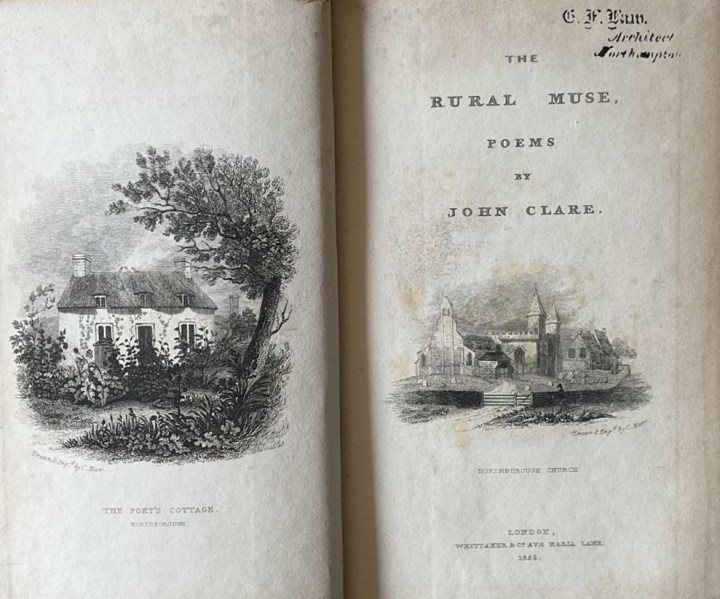
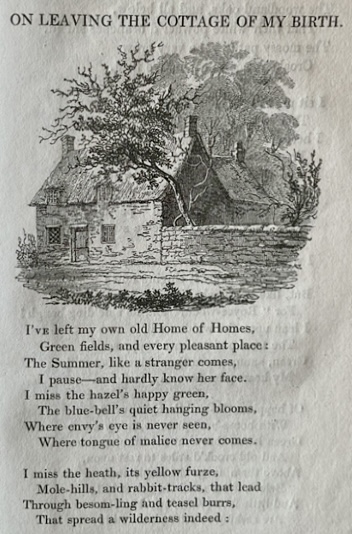
It was after the move to Northborough that Clare wrote some of his most compelling poems of alienation, including ‘Decay: A Ballad’ and his recollections of his favourite Helpston surroundings and pastimes in ‘Remembrances’. But perhaps his most powerful poem was ‘The Flitting’ first published in a partial form in his final collection The Rural Muse (1835) as ‘On leaving the cottage of my birth’ and dated 20 June 1832. Its opening four lines (see image below) continue to speak for exiled people across the world today.
Other Northborough poems, however, suggest that ‘Clare sought to embed himself in his new environment by identifying with a bird that found its home among the dykes, marshy flats and stagnant floods’. (JB 390). Examples being ‘Lover of swamps’ and ‘To the Snipe’.
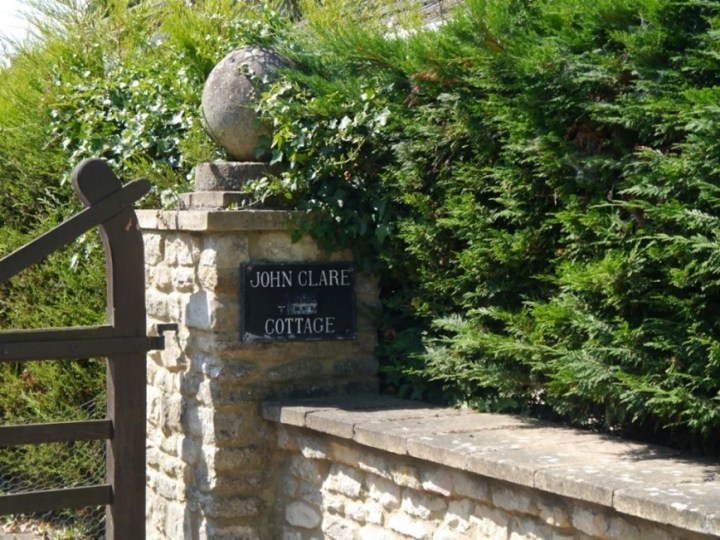
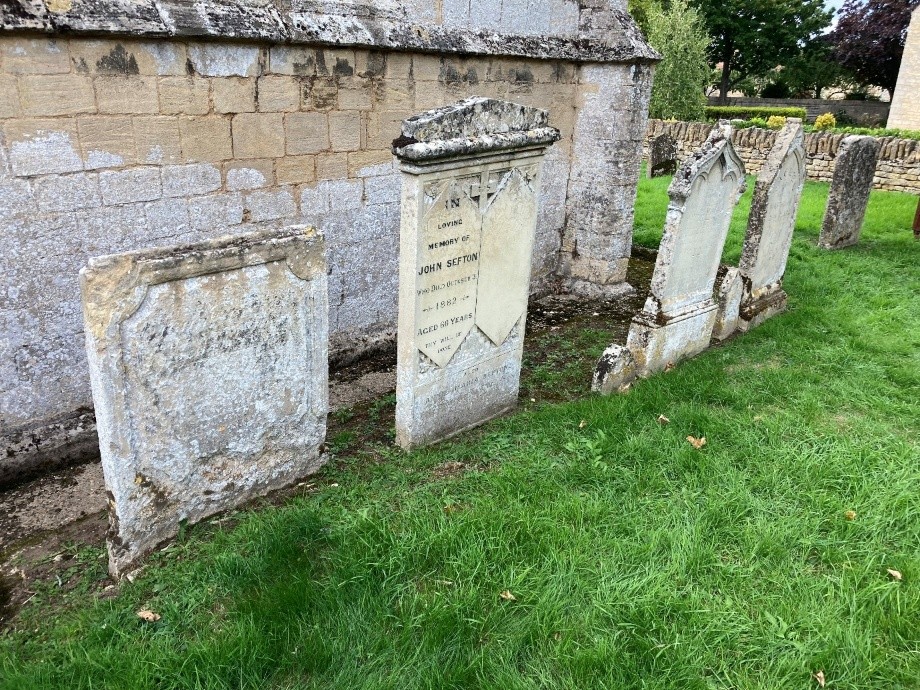
John Clare’s mental health remained fragile and he was to spend just short of five years in Northborough before going to asylums in High Beach (July 1837- July1841) and then Northampton (December 1841-May 1864). Patty was to live in Northborough for the rest of her life, and she and her family were popular in the village. She died on 5 February 1871 during a visit to her daughter Eliza in Spalding and was buried in St. Andrews Church, Northborough, alongside some of her children and family members. The cottage, now named John Clare Cottage, still stands in its own grounds in Church Street, Northborough.
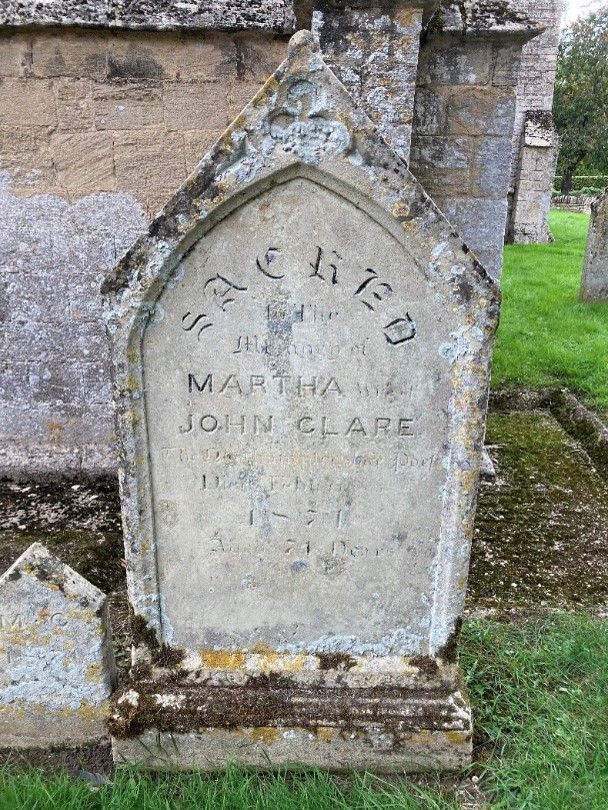
In 2025 a group of enthusiasts in Northborough organised a very successful weekend of events, ‘Poesies for Patty’, at St Andrews Church to celebrate the life of Martha ‘Patty’ Clare. A second event will take place on Sunday 12 July 2026 as part of a John Clare Society Festival weekend. It will begin at 10:30 at the John Clare Cottage, Helpston, with a walk to Northborough retracing the steps of the Clare family in 1832. In the afternoon there will be two talks introduced by Mike Mecham; Claire Richardson, ‘Martha Clare’s Northborough’; and James Keech ‘Northborough’s Overseers of the Poor Book’, with John Clare’s entry as a contributor to the Poor Rates. A refurbishment of this newly discovered book was supported by a donation from the John Clare Society.
Mike Mecham
Website
St Andrews Church, Northborough
Sources
The above text has drawn on the following sources:
Edward Story, A Right to Song: The Life of John Clare (London: Methuen, 1982).
Jonathan Bate, John Clare: A Biography (London: Picador 2003). Shown as JB in the text.
Eric Robinson and David Powell (eds), John Clare By Himself (Ashington: Carcanet, 1996
J W and Anne Tibble, John Clare: A Life (London: Cobden-Sanderson, 1932).


You must be logged in to post a comment.