The weekend of the 12/13 September 2026 saw family and friends gather in New Malden (Saturday) and then Wisley Gardens (Sunday) to celebrate the one hundredth birthday of Dorothy Rose, the great-great-granddaughter of John Clare. A photograph from the Saturday event is shown below together with a profile of Dorothy first published in issue 157, June 2026, of the John Clare Society Newsletter.
DOROTHY MURIEL ROSE (born 13 September 1926)
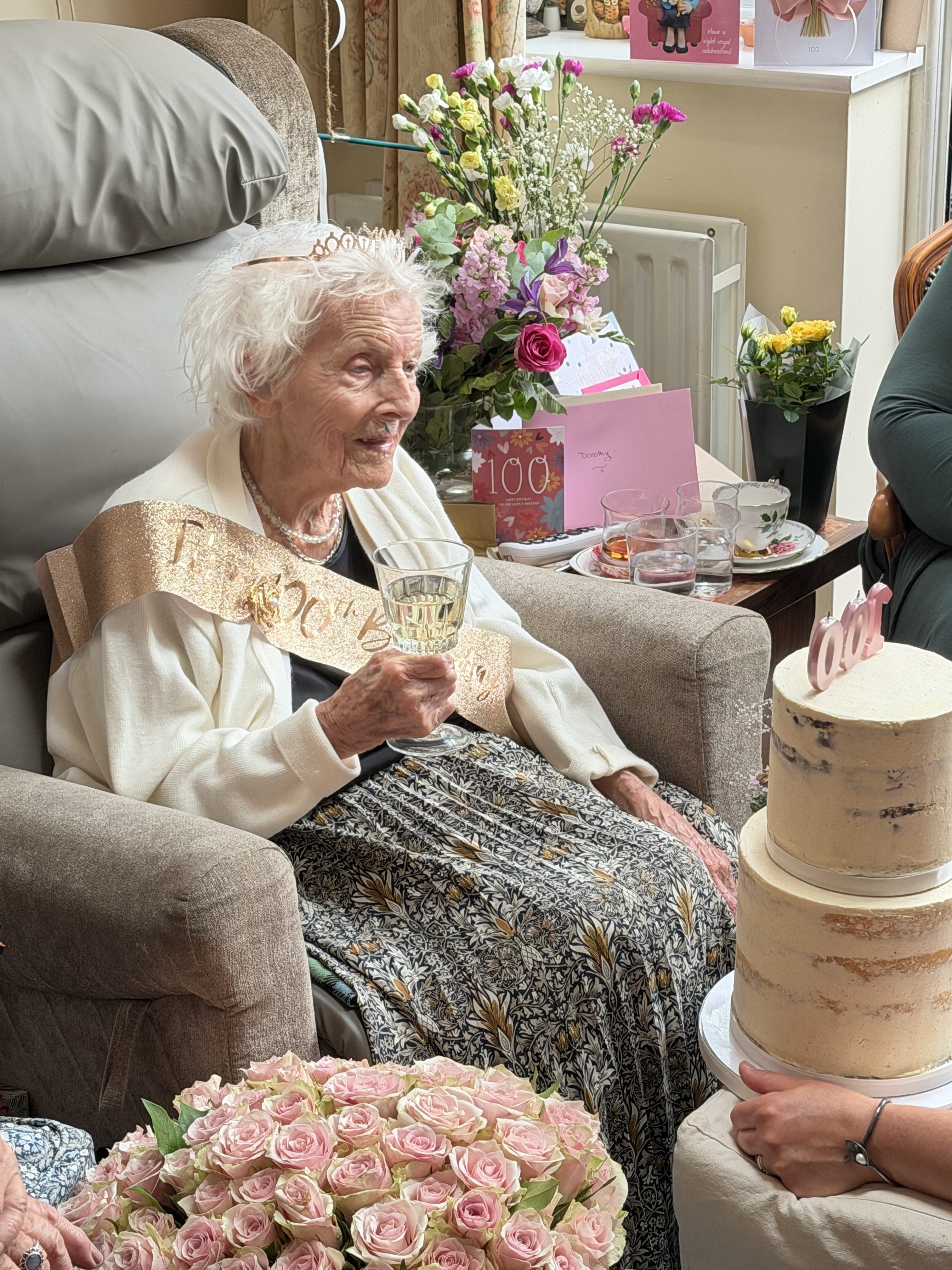
The great pleasure of my year as Chair has been my growing friendship with Dorothy Rose (née Stokes), the great-great-granddaughter of John Clare, who will be 100 on 13 September. During several visits to her home in New Malden, Surrey, I have had wide-ranging conversations with her about her life and family history. Her acute sense of recall and capacity for detail are astonishing and a blessing for anyone interested in John Clare’s family history. I am also indebted to the late Mary Moyse for her research on the Clare family (see John Clare Society Journal vol. 8, 1989). This profile celebrates Dorothy’s rich life and her heritage, opening with this presentation of her lineage:
Dorothy Rose Lineage. John + Patty (née Turner) Clare → Eliza Louisa Clare + John Sefton → John Clare Sefton + Eva Humber → Muriel Clare Sefton + William Austin Stokes → Dorothy Muriel Stokes + Eric Rose → Glenn E. Clare Rose
Dorothy’s great-grandfather was John Sefton (1816–1902) who married her great grandmother, Eliza Louisa (1822–1906), John Clare’s daughter, in Northborough in 1845. He had previously been married to John Clare’s eldest daughter, and first born, Anna Maria (1820–1844), who had died with their daughter the year before. John and Eva Sefton, in a marriage which lasted nearly sixty years, had ten children, including Dorothy’s grandfather, John Clare Sefton (1850–1935). He married her grandmother, Eva Humber of Derby, a cousin of the Humber motor manufacturing family. They had three children, one boy and two girls, one of which was Dorothy’s mother, Muriel Clare Sefton. Muriel married William Austin Stokes, a sailor who fought at the Battle of Jutland during the First World War and then saw service during the Second. Dorothy was their only child, though her father had four brothers who were all sailors. She was born in the naval town of Southsea on 13 September 1926. In 1948 she married Eric Charles William Rose (1927–2024), a police officer from Suffolk. They were married for almost seventy-six years and had one son, Glenn, who was an active member of the John Clare Society and one time Committee member.
Dorothy’s own realisation of her John Clare heritage came when she was a six-year-old at school in Southsea. She came home one day excitedly telling her mother about a wonderful poem her teacher had read to the children. Her mother told her that it had been written by her great-great-grandfather. That was, of course, John Clare and the poem she recalls was the much-loved ‘Little Trotty Wagtail’.
Sustaining John Clare’s literary heritage has been important for Dorothy and her family. She may well have inherited the passion from her great-grandmother Eliza Louisa Clare, who, as Mary Moyse notes, was particularly concerned about promoting her father’s literary achievements. Eliza and her two sons, Samuel (1860–1947) and Dorothy’s grandfather John Clare Sefton, contributed much to the John Clare Centenary exhibition in Peterborough in 1893. Mary Moyse also tells us that John Clare Billings, the son of John Clare’s sister Sophia, was said to be a great enthusiast for his uncle’s work. Dorothy became associated with the John Clare Society from the outset in 1981. She responded to a letter in The Times from the Rev. Brian Blades appealing for descendants of John Clare to contact him. She attended the first festival in Helpston in 1982 and when Mary Moyse published her research on the Clare family, Dorothy was one of her key informants. She would return every year until she was ninety, often visiting Northborough where a number of the Clare family graves, including that of ‘Patty’ and Dorothy’s great-grandfather, John Sefton, can be found.
With so many direct descendants of John and Patty Clare, particularly from their children Eliza and John, there grew a large family network scattered across different places. Mary Moyse notes that they are widely dispersed and several were members of the John Clare Society. Dorothy remembers, as a girl, visits from her grandfather’s brothers and sisters. Perhaps also descendants of her great uncle John Clare, the poet’s son (1826–1911), who went to the Welsh border country to find work as a carpenter working on the railway and stayed. His descendants can still be found in Wales, while one of his daughters, Sophia Margaret Ann Clare (1865–1923), married a doctor in Dublin and had several children there. 2026 is also the 200th anniversary of his birth and a fascinating article, again by Mary Moyse, can be found in the 1998 issue of the Society’s Journal (vol. 17).
Many of John Clare’s possessions, including his library, went to the Northampton Museum. But some artifacts remained in the family. Eliza’s set of silver spoons were split between family members and Dorothy has three. She also has a Victorian tea set which she believes could have been a wedding present for Eliza and John Sefton and has been passed down. But sadly, John Clare’s inkwell, which was in the possession of an aunt, was broken and eventually disposed of.
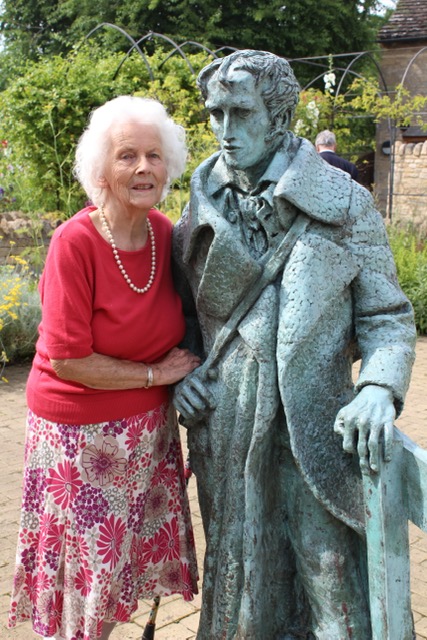
Visiting Dorothy can feel like entering John Clare’s world. There are reminders everywhere: family photographs, heirlooms, books and Society material. Among many memorable moments two stand out. Dorothy was visibly moved when I read to her Clare’s poem ‘How Can I Forget’ from Clare’s People, a phrase Clare also used at the end of his account of the ‘Journey Out of Essex’; and also when she told me how moved her husband Eric was when they visited the John Clare Cottage and she gently stroked Richard Austin’s statue of John Clare in the courtyard. Her love and admiration for her great-grandfather and rich family heritage is unquestionable, and her memories are a great privilege for me to share.
Mike Mecham


You must be logged in to post a comment.